

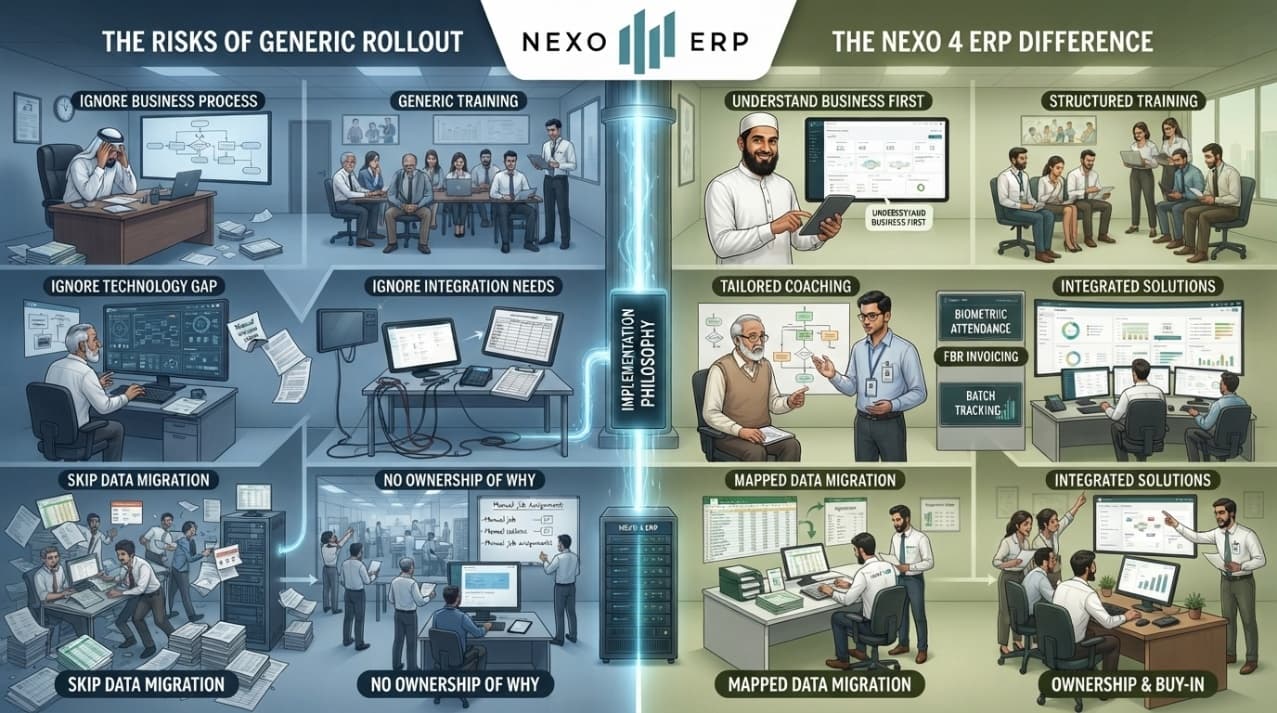
Ask any business owner in Pakistan who has tried to implement an ERP system, and you will likely hear a familiar story: expensive software, months of operational disruption, a system that never fit the business, and a quiet return to Excel sheets and paper registers.
This outcome is not rare—it is the norm across local industries. The failure is rarely caused by software limitations; it stems from how implementations are executed.
Most ERP vendors—and even some ERPNext implementation partners—approach rollouts backwards: install the software, run a generic demo, and expect the business to adapt to the system. A Pakistani company that has operated on paper registers, spreadsheets, and informal approvals for decades does not work like a standard silicon-valley template.
Common Implementation Pitfalls vs. The NEXO ERP Approach
A side-by-side comparison of why traditional rollouts breakdown in Pakistan, and how our process protects your operational continuity.
| Common Pitfall in Pakistan | The NEXO ERP Approach |
|---|---|
| Forcing generic, out-of-the-box templates | Mapping custom purchase-to-production workflows before configuration. |
| Overlooking non-technical staff | Structured, hands-on user training delivered in Urdu and English. |
| Rushed or dirty Excel data migration | Pre-migration data scrubbing, validation, and parallel-run testing. |
| Treating local compliance as an add-on | Native integration of biometric attendance, payroll tax, and FBR digital invoicing. |
The 6 Most Common Failure Points
Through years of auditing distressed rollouts across Lahore, Karachi, and Faisalabad, we have identified 6 root causes behind ERP failures:
- Treating Implementation as Software Installation, Not Business Engineering: Installing default modules without mapping the real procurement-to-production-to-sales cycle on the factory floor.
- Ignoring the Technology Gap: Rolling out complex software without accounting for floor managers and store staff who have limited enterprise software experience.
- Rushing Legacy Data Migration: Uploading unverified opening balances and messy customer ledgers from spreadsheets without parallel ledger reconciliation.
- Surface-Level Staff Training: Delivering single English-only walkthrough sessions rather than repetitive, role-based hands-on coaching in Urdu.
- Treating Integrations as Afterthoughts: Omitting biometric machine syncing, FBR Tier-1 POS integration, and batch tracking from the primary project scope.
- Lack of Employee Ownership: Framing the system as a surveillance tool rather than an operational assistant that makes daily work easier.
Critical Takeaway
If your ERP partner does not spend time on your physical plant floor or warehouse before configuring software, your implementation carries high operational risk.
Case Studies: Turning High-Risk Projects into Operational Success
Practical examples from Pakistani enterprises that modernized operations with tailored ERPNext implementations:
- Lal Khan Oil Mills (Edible Oil & Agriculture Processing): Replaced manual registers with automated seed crushing, bulk procurement, and oil distribution workflows without operational downtime.
- Vital Petroleum (Oil & Gas Logistics / Energy): Digitized workforce management with automated biometric attendance syncing, custom salary structures, and an Employee Self Service (ESS) portal.
- Pak United Foods (Retail, Bakery & Restaurant Chain): Unified multi-branch POS, central commissary inventory, recipe management, and accounting onto a single live dashboard.
The 5-Question Vendor Evaluation Checklist
Before signing an implementation agreement with any ERP consultant in Pakistan, ask these five questions:
- 1. Will you map our operational workflows on-site before configuring the software?
- 2. How do you clean, validate, and test historical data during migration from Excel or legacy systems?
- 3. Is user training delivered hands-on in Urdu for non-technical operations staff?
- 4. Are FBR digital invoicing, local tax rules (PRA/SRB), and biometric attendance integrated into the primary scope?
- 5. Can you share verifiable local case studies in our industry?
Buyer Rule of Thumb
If an implementor cannot provide verifiable local customer references and a detailed data migration protocol, do not risk your business operations with them.
Need Guidance for Your ERP Project?
Speak directly with our implementation consultants to assess your requirements, workflows, and budget—honestly and without sales pressure.
Related Articles
ERPNext vs Odoo in Pakistan: Which ERP Is Better for Your Business? (2025)
Compare ERPNext and Odoo for Pakistani businesses based on cost, compliance, customization, support, and industry fit.
ERPNext Implementation Cost in Pakistan: What to Expect in 2025
A practical pricing guide for ERPNext implementation, migration, customization, and support for Pakistani businesses.